Home » Patents (Page 50)
Category Archives: Patents
Unitary patent – Everybody expects the Spanish Opposition!
 Having (probably) failed in their attempt with Italy to derail the unitary patent package by poking the enhanced cooperation procedure with “the soft cushions” (see here), Spain has now wheeled out “the Comfy chair” and is bringing two further cases in front of the CJEU to try and stop the unitary patent system from going forward. (Those of you wondering why I’ve suddenly developed a soft furnishings fixation are respectfully referred here.)
Yes, Spain has now filed actions C-146/13 and C-147/13 at the CJEU against the European Parliament and the European Council (against Council Regulation (EU) No 1257/2012 [implementing enhanced cooperation in the area of the creation of unitary patent protection] & Council Regulation (EU) No 1260/2012 of 17 December 2012 [implementing translation arrangements] – see here).
So what does this mean for the prospects of the system?
Twitter patent surfaces off the starboard bow

tweet tweet
IPcopy took a quick look at the Twitter Innovator’s patent agreement recently and concluded that there was probably enough wiggle room in the agreement to allow Twitter to start legal actions against most people should they want to do so (see the earlier post here).
One thing that struck us at the time of writing the earlier article was the relative lack of Twitter patents and patent applications (we could only find three such patent documents and one of these belonged to TweetDeck).
Now comes news that Twitter has been working on another patent filing which reads much more closely onto their core business. This now granted US patent (US 8401009) can be found here. So, I hear you ask (probably), “How come you didn’t see that coming”? Good question.
The Unitary Patent Package: What obstacles remain? The latest facts and rumours.
 Before the Unitary Patent Package can take effect there are various legal obstacles that need to be cleared. Some decisions are still to be made (the scale of fees being one that IPCcopy is particularly keen to hear about), and some legal hoops are still to be jumped (ratification, and amendment to the Brussels I Regulation being the most significant).
So, what remains to be dealt with before the first unitary patent can be granted, and when can we realistically expect the way to be cleared?
Here, IPCopy breaks down the procedures that remain, and takes a look at the word on the street regarding the likely processes and timescales for each.
Unified Patent Court – Sunrise provision for Opt-out requests?
 Wragge & Co held an excellent breakfast seminar yesterday (lovely bacon butties!) on the Unified Patent Court. The seminar provided a good overview of the unitary patent package as it stands today as well as highlighting outstanding issues and areas of interest.
One issue that was raised was the possibility of a “sunrise” provision being introduced to give patentees of nationally validated EP patents a protected period after the system goes live in which to register an opt out of the competence of the unified patent court.
Such a sunrise provision is being discussed because of the possibility of tactical revocation actions being brought by third parties against such nationally validated EP patents in order to fix those patents within the competence of the unified patent court before an opt out (from the UPC) has been filed by the patent proprietor.
Avoiding the unified patent court – Do our eyes deceive us? Answer: No!
 In an earlier post – Avoiding the unified patent court – Do our eyes deceive us? – we asked whether the transitional provisions of the unified patent court agreement (see Article 83 of the final text [previously Article 58]) meant that an applicant could opt out of the competency of the unified patent court during the transitional period and that the opt-out would continue throughout the life of the patent.
Since the transitional periods are planned to run until at least either 1 January 2021 or 1 January 2028 this interpretation of the unified patent court agreement would mean that, for European patent applications filed prior to the end of the transitional period, national courts could still have competence to hear patent cases until the 2040s!
In a statement on 18 February 2013, the Commission clarified their position and confirmed that, as suspected in our earlier post, the opt-out will last for the life of the patent.
European Divisional Applications – EPO Consultation
 Rule 36 EPC was amended in 2010 to introduce 24 month time limits for filing divisional European patent applications from a parent European patent application. One purpose of the rule amendment was to address the issue of precautionary divisional filings that were filed to avoid adverse decisions.
An online consultation, with a closing date of 5 April 2013, recently popped up on the EPO’s website (here) announcing that the EPO is going to take another look at Rule 36 EPC and the time limits for filing divisional applications.
Bulgaria join Unified Patent Court Agreement Club
As of 5 March 2013, Bulgaria is also a signatory to the unified patent court agreement. This brings the total number of countries who have signed the agreement to 25 (out of 27). Poland and Spain remain outside the club.
IPcopy’s Ratification Game post has been updated – see here.
The Press Release is here.
Mark Richardson 6 March 2013
Twitter’s patent agreement with inventors – a closer look
tweet tweet
The “smartphone wars” have been in the news for a while now and have spawned a host of comments about the use of patents and the amount of litigation in this arena. Amongst all this commentary you may have come across Twitter’s Innovator’s Patent Agreement (the IPA). Wired recently carried an article by Ben Lee who is the head of litigation and intellectual property at Twitter. The article can be seen here and the agreement itself is also available here.
Twitter suggest that they don’t want patents to impede innovation and the IPA is their answer. According to Twitter, the IPA essentially provides “a promise not to sue anyone unless for a defensive purpose”. We thought we’d take a closer look at the IPA and see whether it can deliver on its promise and what it means for Twitter.
UPC – The Ratification Game Update
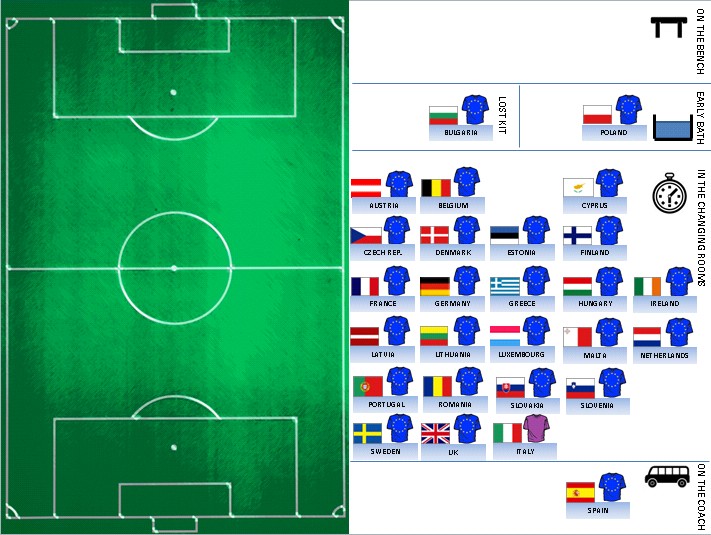
 As noted in an earlier post the agreement on the unified patent court (UPC) was signed by 24 member states on 19 February 2013.
Spain, Poland and Bulgaria were the three member states who did not sign the UPC agreement. Spain are sitting out of the unitary patent package completely at present and so have not signed. Poland and Bulgaria are part of the enhanced cooperation club that the unitary regulations have been prepared under. Poland, however, has decided to take a wait-and-see approach and so did not sign the UPC agreement. Bulgaria intends to sign as soon as it has made appropriate preparations.
In light of the UPC signing ceremony the Ratification Game post has been updated along with the football info-graphic. The full post can be found here but in the meantime here’s the updated graphic.
 IPcopy