Home » Posts tagged 'unified patent court' (Page 12)
Tag Archives: unified patent court
UK Intellectual Property Policy Reform: Newsbites from the Westminster Legal Policy Forum
IPCopy welcomes K2 IP Attorney Adam Brocklehurst for his inaugural blog post, which we hope will be the first of many! Adam was our reporter-on-the-ground at the Westminster Legal Policy Forum on 30 April 2013, and you can enjoy his whistle-stop-tour of the event here.
The Westminster Legal Policy Forum gathered in Whitehall this week for a wide-ranging discussion of hot IP policy and political topics. IP Copy was there to pick up any interesting tidbits. Headliners were HHJ Birss, Baroness Wilcox, Sean Dennehey, representatives from the European Commision, and various speakers from practice and industry.
The Unitary Patent and Post-grant Amendment
 At a CIPA webinar on the Unitary Patent on 15 March 2013, a comment from a member of the panel took us rather by surprise: a suggestion was made that there is no provision in the UPC Agreement for post-grant amendment.
This IPCopy writer promptly dove for her well-worn copies of the Regulation and the Agreement, streams of obscure patent doomsday situations running through her head, and words of disbelief cascading in the direction of her unfortunate office-mates (such are the hazards of an open plan)*. Could this be true?
Well, yes and no, it seems… (more…)
Unitary Patent Package: Updated Q&A
Back in December we posted an in-depth Q&A about the unitary patent package, taking you on a whistle-stop tour of the unitary patent, the unified patent court, and what it might mean for patent owners and IP professionals.
Much of the picture remains the same, but there have been a few changes in recent months, and IPCopy has updated its Q&A for your reading pleasure. So, just in case you didn’t enjoy it enough the first time round, welcome to the Unitary Patent Q&A 2: The Update…
The Unitary Patent Package: What obstacles remain? The latest facts and rumours.
Before the Unitary Patent Package can take effect there are various legal obstacles that need to be cleared. Some decisions are still to be made (the scale of fees being one that IPCcopy is particularly keen to hear about), and some legal hoops are still to be jumped (ratification, and amendment to the Brussels I Regulation being the most significant).
So, what remains to be dealt with before the first unitary patent can be granted, and when can we realistically expect the way to be cleared?
Here, IPCopy breaks down the procedures that remain, and takes a look at the word on the street regarding the likely processes and timescales for each.
Unified Patent Court – Sunrise provision for Opt-out requests?
 Wragge & Co held an excellent breakfast seminar yesterday (lovely bacon butties!) on the Unified Patent Court. The seminar provided a good overview of the unitary patent package as it stands today as well as highlighting outstanding issues and areas of interest.
One issue that was raised was the possibility of a “sunrise” provision being introduced to give patentees of nationally validated EP patents a protected period after the system goes live in which to register an opt out of the competence of the unified patent court.
Such a sunrise provision is being discussed because of the possibility of tactical revocation actions being brought by third parties against such nationally validated EP patents in order to fix those patents within the competence of the unified patent court before an opt out (from the UPC) has been filed by the patent proprietor.
Avoiding the unified patent court – Do our eyes deceive us? Answer: No!
 In an earlier post – Avoiding the unified patent court – Do our eyes deceive us? – we asked whether the transitional provisions of the unified patent court agreement (see Article 83 of the final text [previously Article 58]) meant that an applicant could opt out of the competency of the unified patent court during the transitional period and that the opt-out would continue throughout the life of the patent.
Since the transitional periods are planned to run until at least either 1 January 2021 or 1 January 2028 this interpretation of the unified patent court agreement would mean that, for European patent applications filed prior to the end of the transitional period, national courts could still have competence to hear patent cases until the 2040s!
In a statement on 18 February 2013, the Commission clarified their position and confirmed that, as suspected in our earlier post, the opt-out will last for the life of the patent.
Bulgaria join Unified Patent Court Agreement Club
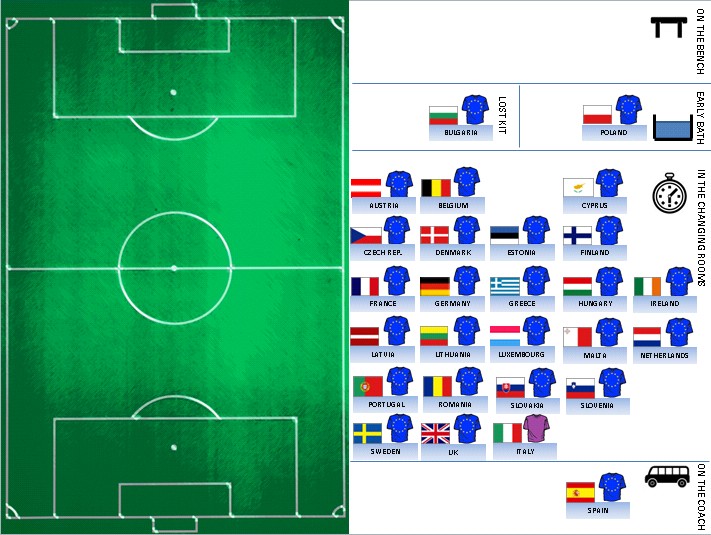
As of 5 March 2013, Bulgaria is also a signatory to the unified patent court agreement. This brings the total number of countries who have signed the agreement to 25 (out of 27). Poland and Spain remain outside the club.
IPcopy’s Ratification Game post has been updated – see here.
The Press Release is here.
Mark Richardson 6 March 2013
UPC – The Ratification Game Update
 As noted in an earlier post the agreement on the unified patent court (UPC) was signed by 24 member states on 19 February 2013.
Spain, Poland and Bulgaria were the three member states who did not sign the UPC agreement. Spain are sitting out of the unitary patent package completely at present and so have not signed. Poland and Bulgaria are part of the enhanced cooperation club that the unitary regulations have been prepared under. Poland, however, has decided to take a wait-and-see approach and so did not sign the UPC agreement. Bulgaria intends to sign as soon as it has made appropriate preparations.
In light of the UPC signing ceremony the Ratification Game post has been updated along with the football info-graphic. The full post can be found here but in the meantime here’s the updated graphic.
Transitional provisions and the competence of the UPC: A response to Amerikat
Over at IPKat, Amerikat has been looking at the transitional provisions of the Unified Patent Court (UPC) Agreement and considering an interesting question. In this post, Amerikat has been considering Article 83, which gives a patentee the possibility to opt out of the ‘exclusive competence’ of the UPC if the patent was filed before the end of the transitional period, and to opt back in again at any time.
In brief, her question is this: does opting out of the ‘exclusive competence’ of the UPC still leave the UPC with non-exclusive competence, or does it leave the UPC with no competence at all (pun entirely unintentional)?
At IPCopy, we threw around some thoughts on this when we first noted quite how long the UK courts could still have competence as a result of Article 83 (Draft Article 58 back when we posted this), and we thought this was an opportunity to share them with you, and Amerikat! (more…)
 IPcopy