Home » Posts tagged 'unitary patent package' (Page 5)
Tag Archives: unitary patent package
Unitary patent – The Italian Job
 As previously noted on IPcopy here, Italy signed the Agreement on a Unified Patent Court back in February but were not “fully paid” up members of the unitary patent package because they hadn’t joined the enhanced cooperation regime on the unitary patent.
We have previously heard that Italy was considering joining the enhanced cooperation regime but according to a news update here some more positive noises have been heard regarding Italy becoming part of the club. (more…)
Unitary patent – Everybody expects the Spanish Opposition! (Part 2)

Back in March we noted that, after their previous joint challenge with Italy against the unitary patent system, Spain had filed two further actions, C-146/13 and C-147/13, at the CJEU against the European Parliament and the European Council. No details were available at the time as to the content of these actions. However, over the weekend this all changed with the publication on InfoCuria of the two actions.
Details of the actions and our initial thoughts are below. In the interests of full disclosure I should probably point out that our initial thoughts are ones of confusion: “what Treaty is that?”, “what does that mean?”, “Have you heard of Meroni?” and “Who’ll be the new Doctor?”*
Unitary Patent Package: Updated Q&A
Back in December we posted an in-depth Q&A about the unitary patent package, taking you on a whistle-stop tour of the unitary patent, the unified patent court, and what it might mean for patent owners and IP professionals.
Much of the picture remains the same, but there have been a few changes in recent months, and IPCopy has updated its Q&A for your reading pleasure. So, just in case you didn’t enjoy it enough the first time round, welcome to the Unitary Patent Q&A 2: The Update…
The unitary patent and contributory infringement – an unforeseen advantage?
Proponents of the unitary patent package have talked long and hard about the benefits they hope it will bring for patentees. The advantages that have been discussed so far have been primarily financial, the grand plan being that reduced translation requirements, a single renewal fee and central litigation will all lead to lower costs in obtaining, maintaining and enforcing your patent.
The ins and outs these financial advantageous, and the wry eyebrows being raised by IP professionals across Europe by way of response, could make for a very long blog post indeed, and we won’t be tackling this one today.
Instead, we have been considering whether the unitary patent might offer an advantage in terms of the actual scope of protection that it provides, specifically with regard to contributory infringement.
Unitary patent – Everybody expects the Spanish Opposition!
Having (probably) failed in their attempt with Italy to derail the unitary patent package by poking the enhanced cooperation procedure with “the soft cushions” (see here), Spain has now wheeled out “the Comfy chair” and is bringing two further cases in front of the CJEU to try and stop the unitary patent system from going forward. (Those of you wondering why I’ve suddenly developed a soft furnishings fixation are respectfully referred here.)
Yes, Spain has now filed actions C-146/13 and C-147/13 at the CJEU against the European Parliament and the European Council (against Council Regulation (EU) No 1257/2012 [implementing enhanced cooperation in the area of the creation of unitary patent protection] & Council Regulation (EU) No 1260/2012 of 17 December 2012 [implementing translation arrangements] – see here).
So what does this mean for the prospects of the system?
Avoiding the unified patent court – Do our eyes deceive us? Answer: No!
 In an earlier post – Avoiding the unified patent court – Do our eyes deceive us? – we asked whether the transitional provisions of the unified patent court agreement (see Article 83 of the final text [previously Article 58]) meant that an applicant could opt out of the competency of the unified patent court during the transitional period and that the opt-out would continue throughout the life of the patent.
Since the transitional periods are planned to run until at least either 1 January 2021 or 1 January 2028 this interpretation of the unified patent court agreement would mean that, for European patent applications filed prior to the end of the transitional period, national courts could still have competence to hear patent cases until the 2040s!
In a statement on 18 February 2013, the Commission clarified their position and confirmed that, as suspected in our earlier post, the opt-out will last for the life of the patent.
UPC – The Ratification Game Update
 As noted in an earlier post the agreement on the unified patent court (UPC) was signed by 24 member states on 19 February 2013.
Spain, Poland and Bulgaria were the three member states who did not sign the UPC agreement. Spain are sitting out of the unitary patent package completely at present and so have not signed. Poland and Bulgaria are part of the enhanced cooperation club that the unitary regulations have been prepared under. Poland, however, has decided to take a wait-and-see approach and so did not sign the UPC agreement. Bulgaria intends to sign as soon as it has made appropriate preparations.
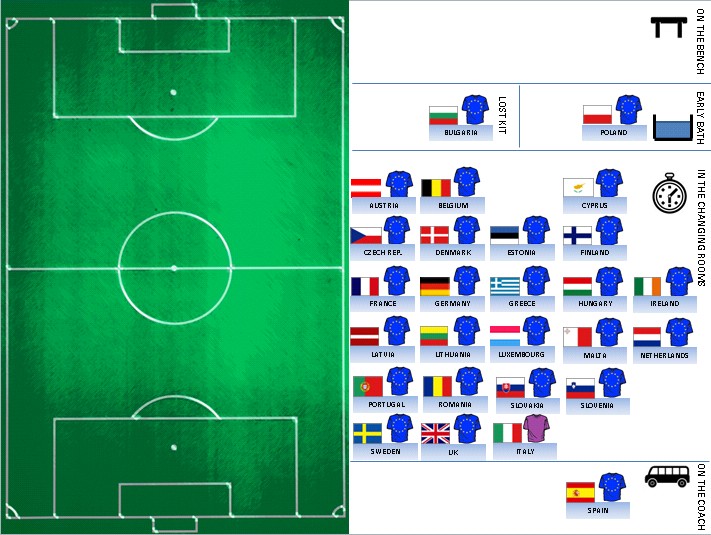
In light of the UPC signing ceremony the Ratification Game post has been updated along with the football info-graphic. The full post can be found here but in the meantime here’s the updated graphic.
Unitary Patent Package – The Ratification Game (The UK completes its ratification formalities)
Update (26 April 2018)
According to the website of the Council of the European Union (and just about every other official IP channel), the UK deposited its instrument of ratification (on 26 April 2018) to become the 16th country to complete its ratification formalities. The UK joins Latvia, Lithuania, Estonia, Italy, the Netherlands, Bulgaria, Finland, Portugal, Luxembourg, Malta, Denmark, Belgium, Sweden, France and Austria as one of the sixteen countries who have completed their ratification processes.
The unitary patent system requires 13 countries to ratify, including the UK, France and Germany. However, the German Constitutional Court challenge has thrown the timescale and the long term future of the unitary patent system into doubt.
There are now enough countries to have ratified the unified patent court agreement that the system will come into effect if Germany completes its own ratification procedures and sufficient approvals to the PPA are obtained.
Now that the UK has completed all of the formalities we have updated our ratification infographic (for an answer to the question “What’s up with this infographic?“, please see the bottom of the post!”).
Why Malta could inadvertently block your unitary patent
 You may have noticed that over here at IPCopy, we’ve been playing with the Unitary Patent Regulation, and testing it to its limits. We’ve already noted some quirks, including the fact that a patentee could potentially opt out of the unified patent court until 2047, and that if an infringement action is brought by an exclusive licensee, bifurcation is all but forced on the defendant.
But this is perhaps the one that’s baked IPCopy’s collective noodle the most so far: assuming that ratification (of the unified patent court agreement) proceeds in time for the Unitary Patent Regulation to come into force 1 January 2014, it appears to us that around one third of the patents that grant that year, and potentially even as many as half, will not actually be eligible for unitary patent protection*.
“How can this be?” I hear you cry! Well it’s all Malta’s “fault”, and here’s why… [we cannot help but think we’ve missed something in the analysis below so feel free to chip in with your thoughts in the comments section!]
Unitary Patent Package – Final texts
 The final text of the Agreement on a Unified Patent Court has now been published by the Council of the European Union. The two regulations relating to the unitary patent have already been published. Links to all three documents are below and also on our unitary patent package page.
1) Regulation (EU) No 1257/2012 of the European Parliament and of the Council of 17 December 2012 implementing enhanced cooperation in the area of the creation of unitary patent protection – here.
2) Council Regulation (EU) No 1260/2012 of 17 December 2012 implementing enhanced cooperation in the area of the creation of unitary patent protection with regard to the applicable translation arrangements – here.
3) Agreement on a Unified Patent Court – here. Corrections to Agreement here and here.
Mark Richardson 17 January 2013
 IPcopy