Home » 2013
Yearly Archives: 2013
European Divisional Applications – Additional Fees published by EPO

As noted earlier on IPcopy, Rule 36 EPC, which was amended in 2010 to introduce 24 month time limits for filing divisional European patent applications from a parent European patent application, is to be amended from 1 April 2014 such that the 24 month deadline rule is removed and the procedure reverts back to the pre-April 2010 arrangements. As well as the change to Rule 36 EPC, an amendment to Rule 38 was proposed to provide “for an additional fee as part of the filing fee in the case of a divisional application filed in respect of any earlier application which is itself a divisional application”.
Administrative Council decision of 13 December 2013 (here) has been published on the EPO website and, as well as detailing other fee changes due to come into effect on 1 April 2014, confirms the level of the additional fee that will be payable on 2nd and higher generation divisional applications from 1 April 2014. The full list of additional fees for divisional applications, which ranges from 210 Euros to 840 Euros, is noted below
The twelve patents of Christmas

Felix was not impressed with his festive headgear and began plotting a messy end for his owner’s favourite shoes
IPcopy will be taking a Christmas hiatus while we all eat too much food and watch Doctor Who, so you will all have to make do without us for a week or two. In case anyone finds themselves in need of an IP-fix over the Christmas period, we’ll leave something to keep you entertained.
And what could possibly be more festive than a good Christmassy invention? Well – twelve Christmasy inventions set to music, that’s what!
All together now: On the first day of Christmas my patent attorney gave to me…
IP Hit or Miss? Code Monkey Save World
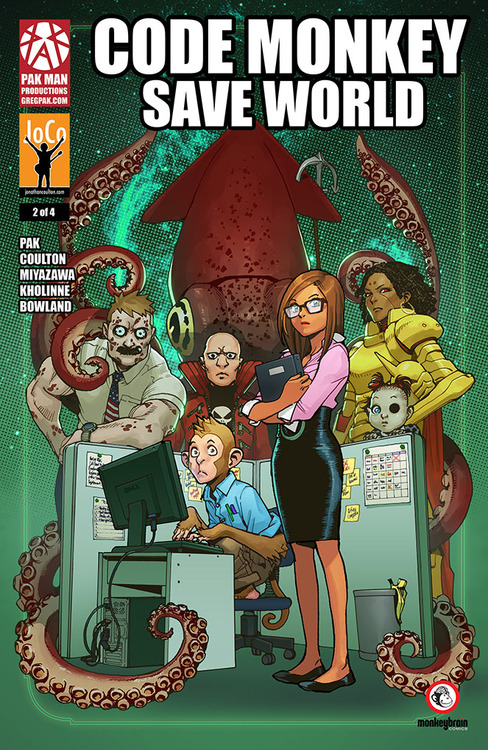
Cover art: Code Monkey Save World Issue 2. Reproduced with permission from Greg Pak (Artist: Takeshi Miyazawa; Colourist: Jessica Kholinne. http://www.codemonkeycomix.com)
Warning: minor spoilers to follow
The Kickstarter-funded graphic novel series, Code Monkey Save World by Greg Pak, tells the story of the eponymous coding monkey, Charles, as he teams up with a lovelorn super-villain (somewhat reminiscent of Dr Horrible in Joss Whedon’s Dr Horrible’s Sing-Along Blog), following the enslavement of Charles’s human co-workers (including his office crush) by Robo-Queen Laura.
The second instalment of the series published earlier this month and features the origin story of the super-villain, Skullcrusher. As they wait for the computer systems in Skullcrusher’s lair to reboot, Skullcrusher explains to Charles that he found his “true talents really revolve around patent law”.
OHIM website returns an “Error 404” message

Despite their best efforts OHIM were unable to organise a successful website launch party in the local brewery
A new OHIM website was recently released to some fanfare. According to the Alicante Newsletter: “The site has been developed in collaboration with users, who have tested its functionalities and provided valuable feedback through the development process”.
Unfortunately however it seems as though the online filing functionality was one area where the site testing may have been a little lacking. There have been some reports appearing online about technical issues (here and the 11 December entry here) and the OHIM website itself has carried a number of announcements regarding this matter. However, based on some recent experiences that we have been made aware of IPcopy wonders if the new OHIM site is currently fit for purpose? (more…)
Patentable subject matter in the US

On 20th September 2013, as part of a CIPA series of webinars, Seth D. Levy (Nixon Peabody) gave a very clear presentation on the state of play with respect to patentable subject matter cases in the US.
Before we get into the review of the presentation it is worth pointing out that although the focus of the talk was on medical diagnostic claims (“a challenging area these days in the US”), there is uncertainty whether there may be wider implications for the software and business method fields in the US.
As such, and speaking as a “software” patent attorney, the subject matter of this presentation should be of interest to all patent attorneys and other interested individuals regardless of their technical field.
The talk covered the following general areas: background to the current state of case law in the US (essentially the Supreme Court prior to Myriad Genetics); Myriad and its aftermath; USPTO Guidance; and prosecution tips. (more…)

Top 10 Points from EPO case law from 2013 (CIPA Event 27 November 2013)
Following on from last week’s guest post from Suleman Ali of Holly IP and K2 about top 10 points from UK Court Decisions in 2013 we now have Suleman’s 10 points from EPO case law in 2013. This post was originally posted on the Holly IP blog and is reproduced with the permission of the author.
These decisions were discussed at a CIPA event on 27 November 2013, and the following points are based on the cases selected by the speakers.
Clause 13: copying, informed users and design trolls

Parliamentary copyright images are reproduced with the permission of Parliament
Last week in the context of Clause 13 of the Intellectual Property Bill we posted some comments on the suitability of a criminal court to hear registered design issues. I mentioned in that earlier post that there were other reasons why we thought the clause should be deleted and some more of these are discussed below.
Remember, if you feel that Clause 13 of the IP Bill should be deleted or amended to restrict its scope then you should lobby your MP. Find your MP here.
Today’s mini rant topic of discussion looks at whether the intent of the legislation has been captured in the Clause as drafted and also looks at the acts of copying and infringement. Finally there are some musings on the how the criminal provisions could be used in practice.
Keltie is 25!

Team photo (embiggenable)
25 years ago, on 12th December 1988, David Keltie Associates started its life with David Keltie and Rosemary Cardas. Last weekend, to mark our 25th birthday, virtually the entire firm decamped to the banks of Loch Lomond in Scotland for a couple of days of celebration, reflections on the journey the firm has made so far and predictions for the journey still to come.
US Supreme Court to take a run at Alice v. CLS Bank
 The US Supreme Court announced on Friday that it is to review the Alice Corp. v. CLS Bank Intl. case. The US Court of Appeal, of course, recently handed down its take on the case (see decision dated 10 May 2013 here) in which the 10 judge panel exhibited something of a split opinion.
At the recent AIPLA event in Washington Chief Judge Rader (one of the 10 judge CAFC panel on the Alice/CLS case) commented that he regarded that case as a personal failure and a failure of his institution (Court of Appeals for the Federal Circuit). Listening to other attorneys at AIPLA a number of feelings were expressed about the case including bafflement, frustration and the merest hint of “the End of Days”.
 IPcopy