Home » Patents (Page 54)
Category Archives: Patents
Guy Fawkes’ Patent Bombshell
 In England the 5th November commemorates the anniversary of the foiling of the infamous Gunpowder Plot of 1605 when a shady group of conspirators came ever so close to assassinating King James I of England along with much of Parliament. As the man caught red handed in the act of stacking the gunpowder under the House of Lords in Westminster, Guy Fawkes’ effigy is burned every year on bonfires across the country for various reasons, many of which are now forgotten to firework toting revellers. Perhaps one of the lesser appreciated reasons to be thankful for the failure of the plot is that less than twenty years later that same Parliament went on to draft the Statute of Monopolies which formed the basis of patent laws for the UK, the European Patent Convention, as well as for many countries with historical links to Britain’s Imperial past including the USA, Australia, Canada, India, South Africa, New Zealand and much of the Commonwealth.
Happy Halloween – the story behind your power plugs….
 It’s Halloween and we have a grim tale for you about the battle to supply electricity to your homes…..
Today we have the smartphone patent wars but 130 years ago it was the Current Wars – AC versus DC, Tesla versus Edison. There could be only one winner and, unfortunately for an elephant named Topsy, Edison was willing to play dirty.
Doctor Who (IP – Hit or Miss?)
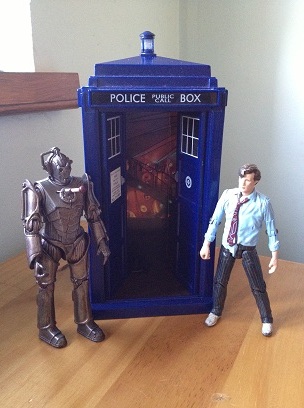
I say old chap. You haven’t seen my sonic screwdriver, have you?
Does The Doctor know his IP from his elbow?
Incidentally, just in case you’re wondering, there is an (admittedly tenuous) intellectual property (IP) connection to this story!
In the episode in question, Silence in the Library (trailer below), the Doctor and Donna are summoned to a planet sized library, The Library, via a message received on the Doctor’s psychic paper where they encounter a team of explorers led by Professor Song and funded by Mr Lux. The Doctor and Donna are encouraged to sign non-disclosure agreements upon encountering the team in order to ensure that their “individual experiences inside the Library are the intellectual property of the Felman Lux Corporation.”
It turns out that The Library has been deserted for 100 years following some kind of incident in which all the occupants of the Library disappeared. When things predictably start to go south the Doctor gets annoyed with Lux and declares “Mr Lux, right now, you’re in more danger than you’ve ever been in your whole life. And you’re protecting a patent?”
Just what does the Doctor mean by his reference to “protecting a patent”? Does it make sense from an IP context? Is it an IP hit or miss? And, am I over-thinking my Saturday night telly?
IP Hit or Miss?
 Ever been watching a film or something on TV and noticed that the intellectual property (IP) reference that just cropped up in the script is wrong? No? Well, you probably manage to get out more than me.
To this author at least (patent attorney, tech nerd and SF geek) references to patents, trade marks and the like seem to pop up quite frequently in the entertainment media.
IP Hit or Miss? is an occasional series of articles that takes a light-hearted look at IP as it appears in the media (films, TV, news reports etc) as an excuse to talk about different IP topics. A vague rating of “IP hit or miss?” may also be given depending on how well the particular IP concept has been incorporated into the media in question.
Want to suggest a film, TV show or other reference that we can take a look at? Drop us an email or leave a comment below.
European Union Unitary Patent is a Few Centimetres Closer
 With the relentless momentum of a rundown mobility scooter, the EU’s various legislative organs appear to be making progress in agreeing the final terms for a Regulation on the unitary patent and unified patent court. Compromises have been brokered and the word in Brussels is that the offending Articles 6-8 may be removed or replaced with something non-substantive. It appears that if the European Parliament adopts the Regulation in Mid-November then the Council may approve it in December or early January 2013. This could allow for the Regulation to come into force in the enhanced cooperation states of the EU (i.e. the EU less Italy and Spain) in late Spring of 2014.
GMO = patenting = evil ?
An interesting story by Charles Eisenstein in The Guardian highlights the way in which patents often become associated with potentially negative aspects of technology. It can sometimes seem as if the word “patent” when associated with a given technology acts as a flag to the reader that this is evil science.
Is standardisation always a good thing in patents?
The EPO and USPTO have announced triumphantly that they have completed the Herculean task of creating a consolidated patent classification scheme that provides up to 250,000 individual definitions for areas of science and technology. This project has been the result of several years’ work to harmonise the previously divergent technical classification systems used in the US and Europe to assist patent examiners in prior art searching and examination of patent applications. In essence, every patent application filed is assessed by an examiner and allocated one or often several classifications that cover the technologies used in the invention. Until now different classification strategies were used by the US and Europe often resulting in divergence in the outcomes of patent prior art searching. The intention of the project, called the cooperative patent classification scheme (CPC), according to EPO President Benoit Battistelli, is to “…align our patent procedures more closely and deliver major efficiency gains”. The Director of the USPTO, David Kappos, is perhaps a little more pragmatic about the benefits stating the new scheme is needed to “…eliminate duplication of work between the two Offices”. In fact it represents another step towards global harmonisation of the patent system which would allow applicants to avoid the current process of prosecuting patent applications according to divergent standards in different countries. Surely from a cost perspective this has to be a good thing, right?
 IPcopy