Home » 2015 (Page 4)
Yearly Archives: 2015
European Patent Litigation Certificate – the Preparatory Committee’s proposal
 As highlighted in our post earlier this week the Preparatory Committee’s proposal for the rules for the European Patent Litigation Certificate were agreed at its early September meeting. These rules have now been published (here) along with an Explanatory memo (here). IPcopy has generated a tracked changes version of the latest proposal showing the changes to the rules since the consultation document (tracked changes document here).
As noted below (and in CIPA’s note sent yesterday to the profession) the proposal as agreed by the Preparatory Committee represents a great deal for the UK patent profession and a huge pat on the back is due to those at CIPA, the UKIPO and elsewhere for their efforts on this front. Based on some of the responses received to the consultation IPcopy can only presume that the CCBE and the IPLA aren’t quite so enamoured with the proposal…..hey ho. (more…)
Unitary patent and UPC Update – September 2015
Summer seems to be drawing to a close so it’s probably time to put the mankini away again for another year. Fear not however because we have the first post-beach update on the unitary patent and the UPC. Covered below are brief updates on Italy in the unitary patent, feedback from the UPC fees consultation, the UPC in London and highlights from the most recent update from the UK’s UPC Taskforce (including news on the EPLC). (more…)
Live or let die? – Formal recommendations to abolish Australia’s Innovation patent system
 Today on IPcopy we have a guest post from Caroline Bommer of Shelston IP on the subject of Australia’s innovation patent system. This post first appeared on the Shelston IP website and has been reproduced with the permission of the author.
In June 2014, following a three year plus review process with a broad range of inputs, ACIP (the Advisory Council on Intellectual Property), published a “final” report on the effectiveness of the Australian innovation patent system. Despite the results of its own economic research commissioned as part of that review, it was unable to come to any clear conclusions regarding retention or abolition of the system, and limited its recommendations to options for addressing concerns regarding the current low patentability threshold. (more…)
Summer Summary
 A Bank holiday plus a torrential downpour must mean that summer’s just about over. Just in case you missed us over the last few weeks, here’s our summer round-up from mid-July through to the end of August. (more…)
Unitary Patent Package – The Ratification Game (Portugal completes its ratification formalities)
 Update (1 September 2015)
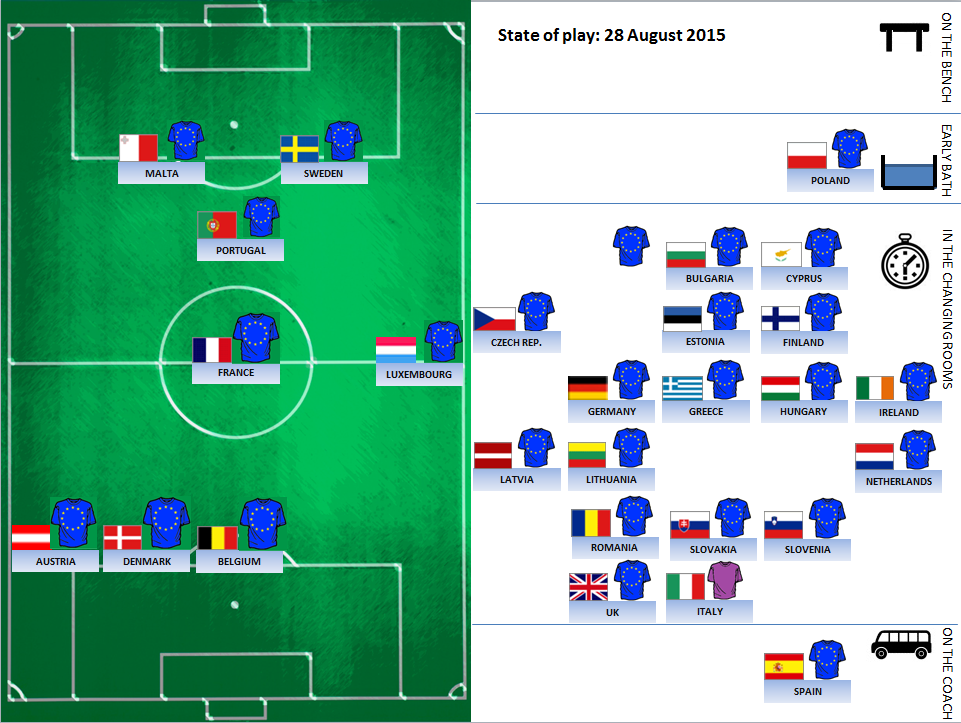
According to the website of the Council of the European Union, Portugal has now deposited its instrument of ratification (on 28 August 2015) to become the eighth country to complete its ratification formalities. Portugal joins Luxembourg, Malta, Denmark, Belgium, Sweden, France and Austria as one of the eight countries who have completed their ratification processes.
Regular readers will recall that we noted last month that Portugal had ratified the UPC Agreement but had not deposited its instrument of ratification in Brussels. Now that Portugal has completed all of the formalities we have updated our ratification infographic (for an answer to the question “What’s up with this infographic?“, please see the bottom of the post!”).
Keltie: Charity Events

This September Keltie teams will be raising money for a range of charities by taking part in the Run the River and Tough Mudder events. Full details including links to their team profiles and charity pages are below. (more…)
US caselaw – countering an obvious combination objection
 We’ve all been there. The Office Action for your client’s latest US patent application contains an inventive step objection based on the combination of two documents. The documents together appear to be relevant to your main claim but the client swears blind that the documents would never be combined to arrive at the invention. What do you do? How can you argue against such a combination of prior art. Well, here is a brief compilation of relevant US cases bearing on the obviousness of combinations*. (more…)
Rihanna, Topshop and a Narrow Opening to Image Rights in the English Legal System?
 The English legal system does not acknowledge image rights. Celebrities cannot claim a monopoly on their image, nor a right to control the use of their name, likeness and other attributes that the public associates with them. Historically, they have resorted, as a compromise, to other forms of protection, such as registered trade marks and passing off (see explanation of passing off below), in particular.
However, a recent appeal judgement by the English Courts indicates that in certain circumstances, and depending entirely on the facts of the case, the Common Law tort of passing off can be “stretched” to prohibit the commercial use of celebrities’ images. This precedent is, in the view of the author, likely to be applied tightly, but presents an opening that celebrities will look to rely on to control the use of their image by unauthorised third parties.
The appeal judgement relates to the entertainment industry and follows a case successfully brought by pop-star Rihanna against the high street retailer Topshop. However, the implications for sports personalities, for whom a large proportion of the earnings originates from product endorsements, are self- evident and possibly greater that those for the entertainment industry. (more…)
A Question of Data Protection
 One trend in sport that is becoming increasingly prominent is the capture (and subsequent processing) of athlete data via wearable devices. While this is usually done for medical, training or performance purposes, the desire on the part of sports bodies to identify new revenue streams is strong and there is no doubt that the demand for this kind of data is growing. Alongside the technological difficulties, one of the most significant obstacles to the successful commercialisation of that data is data protection. Nick White, Partner at Couchmans LLP, examines the treatment of athlete personal data gathered via wearable technology and does so through the lens of the recent general approach adopted by the Council of the European Union (‘the Council’) on 15 June 2015 concerning the proposed draft General Data Protection Regulation (‘GDPR’). (more…)
Meisterkreis: German Luxury Brands United Against Counterfeiting
 Following on from IPCopy’s 3 July post reporting from the Marques Luxury Brands Symposium that took place in Zurich at the end of June 2015, we are now bringing you a summary of the presentation given at the Symposium by Clemens Pflanz, founder and CEO of Meisterkreis. (more…)
 IPcopy