Branding – is monolithic best?

BMW: A monolithic brand. Shown here on the IPcopy news wagon
Consider a company selling non-pharmaceutical products to the general public (pharmaceutical products raise special issues, not discussed here).
The possible extremes of branding architecture are these:
- “one product [or product type, or service (type)], one brand”; and
- “monolithic”. (more…)
Professional ethics – a bit like Isaac Asimov’s Laws of Robotics

“A Dalek may not injure a Timelord or, through inaction, cause a Timelord to come to harm! …. Son, we need to have a serious chat”
Isaac Asimov (1920-1992) is one of the Greats of science fiction. While practising as a chemist in the 1940s, he depicted in his stories a world in which, from the late twentieth century, humanity was increasingly served by robots of high intelligence. To prevent these robots from taking over from, or destroying, humanity – or being abused by one human against others – they were programmed with the three “Laws of Robotics”:
“1 – A robot may not injure a human being, or, through inaction, cause a human being to come to harm.
“2 – A robot must obey the orders given to it by human beings except where such orders would conflict with the First Law.
“3 – A robot must protect its own existence as long as such protection does not conflict with the First or Second Law.”
These laws were admirably crafted, but had enough ambiguity to support ingenious stories. The stories are still readily available (the above laws are as set out in a recently purchased copy of I, Robot.)
A legal practitioner such as an English solicitor or a UK and European patent attorney is likewise subject to hierarchical rules embodied in codes of conduct of various types. In the public interest, their behaviour is constrained, including their response to client instructions. Indeed, with a little licence, one may reformulate these ethical codes into three-part form corresponding quite well to the three Laws of Robotics: (more…)
10 Points from IPO Patent Decisions in 2013
 In his final post reviewing a CIPA event on 27 November 2013 Suleman Ali of Holly IP and K2 looks at UKIPO decisions in 2013. This post was originally posted on the Holly IP blog and is reproduced with the permission of the author.
IP Hit or Miss? Code Monkey Save World
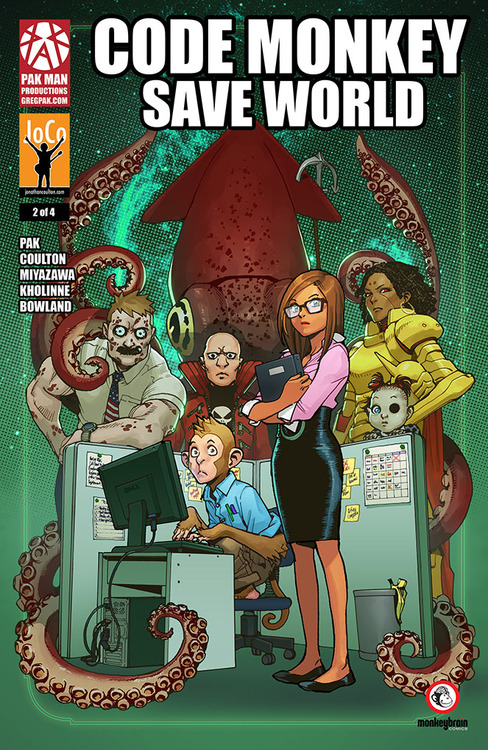
Cover art: Code Monkey Save World Issue 2. Reproduced with permission from Greg Pak (Artist: Takeshi Miyazawa; Colourist: Jessica Kholinne. http://www.codemonkeycomix.com)
Warning: minor spoilers to follow
The Kickstarter-funded graphic novel series, Code Monkey Save World by Greg Pak, tells the story of the eponymous coding monkey, Charles, as he teams up with a lovelorn super-villain (somewhat reminiscent of Dr Horrible in Joss Whedon’s Dr Horrible’s Sing-Along Blog), following the enslavement of Charles’s human co-workers (including his office crush) by Robo-Queen Laura.
The second instalment of the series published earlier this month and features the origin story of the super-villain, Skullcrusher. As they wait for the computer systems in Skullcrusher’s lair to reboot, Skullcrusher explains to Charles that he found his “true talents really revolve around patent law”.

Top 10 Points from EPO case law from 2013 (CIPA Event 27 November 2013)
Following on from last week’s guest post from Suleman Ali of Holly IP and K2 about top 10 points from UK Court Decisions in 2013 we now have Suleman’s 10 points from EPO case law in 2013. This post was originally posted on the Holly IP blog and is reproduced with the permission of the author.
These decisions were discussed at a CIPA event on 27 November 2013, and the following points are based on the cases selected by the speakers.
Keltie is 25!

Team photo (embiggenable)
25 years ago, on 12th December 1988, David Keltie Associates started its life with David Keltie and Rosemary Cardas. Last weekend, to mark our 25th birthday, virtually the entire firm decamped to the banks of Loch Lomond in Scotland for a couple of days of celebration, reflections on the journey the firm has made so far and predictions for the journey still to come.
Top 10 Points from UK Court Decisions from 2013 (CIPA Event 27 November 2013)
Today we have a guest post from Suleman Ali of Holly IP and K2. This post was originally posted on the Holly IP blog IP Trends and is reproduced with the permission of the author.
These decisions were discussed at a CIPA event on 27 November 2013, and the following points are based on the cases selected by the speakers.
IP News Nuggets
 Here’s a selection of IP related news articles that caught the eye of IPcopy in the last few days. (more…)
IP Bill & Clause 13 – an IPcopy response to an ACID response to a Katpost

Parliamentary copyright images are reproduced with the permission of Parliament
Last night IPKat posted a reply from Dids Macdonald of ACID on the recent series of posts relating to Clause 13 of the Intellectual Property Bill. Merpel (of IPKat) interspersed some comments into Dids’ views which helped throw a light on some of the comments being made.
However, having read the post a couple of times we felt moved to write a response to the post on IPKat. Since the resultant response was so long we’ve posted it here on IPcopy and have submitted a link to this article for inclusion in the comments section of the original post on IPKat. (more…)
 IPcopy