Home » Patents (Page 53)
Category Archives: Patents
Unitary Patent Package – the national patent alternative
 As noted in Emily Weal’s earlier post on the subject (see here) patent applicants will still have the option of opting out of the unitary patent package if desired and applying for direct national patents.
A note of caution was sounded in the earlier post highlighting that not all of the 25 European countries that are part of the unitary patent package permit national phase entry from a PCT application.
In this post we take a closer look at which countries you need to keep an eye on.
Unitary Patent Package – Q&A
This is IPcopy’s original Q&A post on the unitary patent package (published 20 December 2012). A more recent and updated version of this post, which was published on 10 April 2013, can be found here.
After last week’s vote in the European parliament (Note: this article was published 20 December 2012), it seems that the unitary European patent really is here to stay. Many of the finer details are yet to be sorted out, and there is plenty of speculation in the patent world right now as to how things will pan out over the next few years. But there’s also plenty that we now know for sure about how the unitary patent will work, and how it might begin to affect your IP decisions, so here on IPCopy are the answers to your burning questions (grab a hot beverage of your choice and get comfy – it’s a long one…!):
Avoiding the unified patent court – Do our eyes deceive us?
 Over at IPCopy we’ve been absorbing the latest version of the agreement on the unified patent court, which you can find here.
We’ll be posting an informative Q&A-style blog entry in the next few days, but in the meantime, we’ve noticed an interesting quirk in the fine print (maybe, have a look below).
Bonza Aussie Rules

Strewth! A patents act amendment?
Following in the footsteps of many other patent offices around the world, Australia has put in place an amendment to the Patents Act 1990 that will come into force on 15 April 2013. In a perceived effort to ‘raise the bar’ of patentability – a catchy but meaningless phrase coined by the European Patent Office a few years ago – a number of new standards have been introduced into the statute. The new measures include a more rigorous approach to examination of inventive step that increases the scope for IPO Examiners to consider obviousness from the perspective of a non-Australian skilled person. There is also a significant reduction in the term for ensuring the application proceeds to acceptance, from 21 months from issuance of the first Examination Report down to a fleeting12 months. The expected effect of these measures is to make it harder to get the broad scope of patent protection that is currently expected by many applicants in Australia.
The advice issuing from many Australian patent attorney firms is for applicants who have pending applications in Australia to request examination before 15 April 2013 in order to benefit from the current more lenient standards. Presumably, those with pending International patent applications could also enter the Australian National Phase early as well if Australia is seen as a key market.
Unitary Patent & Unified Patent Court
 Last week the pan-European Intellectual Property Summit (IP Summit) was held in Brussels and the first morning of the summit saw a number of discussions regarding the unitary patent and unified patent court. A common theme that seemed to crop up from anyone representing the official EU position was that the proposed unitary patent protection (UPP) package isn’t perfect but it’ll do! Hmm.
The opening keynote introduction was from Kerstin Jorna from the European Commission (Director, Intellectual Property – Internal Market & Services DG) who likened the UPP package to a cake that doesn’t look like the picture in the recipe book when you remove it from the oven. According to Ms Jorna in such circumstances we should ask ourselves whether the cake is fit to be served to our family! Apparently the UPP cake is fit to be eaten. Please insert your own joke here about too many cooks in the kitchen….
The UK Intellectual Property Office – 160 years young
 Next year the London Underground is 150 years old. With an extensive maintenance project underway some might say it is showing its age.
The UK Intellectual Property Offfice on the other hand celebrates 160 years this year and this IPcopywriter believes it is a case of 160 years young rather than 160 years old.
Einstein’s Fridge
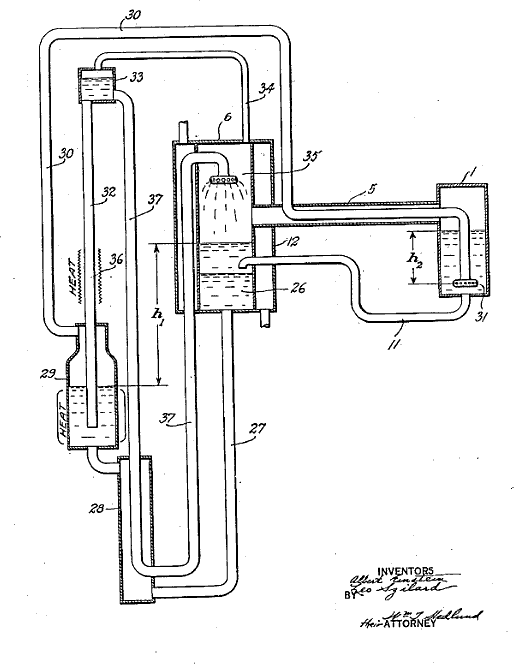 We all know a bit about Albert Einstein – genius, Patent Office examiner, purveyor of a noteworthy moustache and also ….inventor of a fridge.
The Hand Test Revisited

Most patent attorneys at some point in their career will have been introduced to the “Hand Test”. This is a rule of thumb (well, four fingers and a thumb) test to determine whether a claim is useful. There are various versions, but a familiar one is for Claim 1 of a patent to be printed out – for the sake of argument and objectivity, let’s say in 12 point Times Roman with one-and-a-half spacing – and for a patent attorney (let’s say one taking size 8 in gloves) to try to cover it with their hand laid flat, with fingers together, on the paper over the printed claim. If there are lines of text showing above or below the hand, the claim is generally not infringed by the embodiment of interest, avoidable by one simple workaround or another, or simply impossible to infringe.
Does Every Experiment Need a Test Tube?
 The UK Intellectual Property Office has recently launched a consultation entitled “The Research and Bolar Exceptions”. While all patent practitioners may have got as far as the end of the title, the profession will split into two groups after reading the subtitle, “A formal consultation on patent infringement in clinical and field trials”, indicating that this is another exercise in sculpting patent law specifically for the pharmaceutical industry.
This all relates to the interpretation of s.60(5)(b) of the Patents Act 1977, which states that:
“An act which, apart from this subsection, would constitute an infringement of a patent for an invention shall not do so if… it is done for experimental purposes relevant to the subject-matter of the invention;”
Most European countries have a similar provision as a result of the harmonisation in European patent law associated with the creation of the Community Patent and European Patent Conventions in the 1970s. Different countries, however, interpret this provision in quite different ways. The UK courts have interpreted this exception narrowly, leading to widespread concern that the UK is out of step in not having a clear exception for clinical trials.
Patent applicants in India: beware the section 8 ‘trap’
 India has become an attractive and apparently low cost option for patent applicants with global interests, but recent Patent Appeal Board and Court decisions suggest that hard-won patents may be invalidated easily on technicality grounds if patent owners do not meet stringent disclosure obligations during the application procedure.
 IPcopy