Home » Posts tagged 'UPC agreement' (Page 2)
Tag Archives: UPC agreement
CIPA Seminar: Getting Practical with European Patents & the UPC – Episode 2
 Last week IPcopy watched the second webinar in the CIPA UP/UPC series “Getting Practical with European Patents & the UPC – Episode 2 – managing the knowns and the unknowns of the ‘opt-out’” which was presented again by Pippa Allen. IPcopy’s post on the first webinar can be found here.
The subject of the second webinar was the opt-out and the presentation covered the legal basis for the opt-out as well as the pros and cons of opting a classically validated European patent out of the competence of the Unified Patent Court (UPC).
Opting out a classical EP patent from the UPC is seen as essentially preserving the status quo as far as a patent owner is concerned since an opted out EP patent is regarded as no longer being within the competence of the UPC. Assessments of the UPC may therefore tend to play up the risk of central revocation without providing much in the way of a counter point of view.
The second CIPA webinar however looked to provide a more balanced assessment of the UPC and also of the option of requesting unitary effect for EP patents that grant after the unitary patent system comes into force. (more…)
CIPA Seminar: Getting Practical with European Patents & the Unified Patent Court – Episode 1
 This post provides an overview of the recent CIPA webinar: Getting Practical with European Patents & the Unified Patent Court – Episode 1 presented by Pippa Allen. This webinar was the first in a series about the unitary patent system. The next seminar is on Getting practical with European patents and the UPC EP2: managing the knowns and the unknowns of the “opt-out”. Future seminars will cover aspects of the unitary patent system referenced here in more detail, e.g. validity and infringement opinions and also a look at the Case Management System (CMS) that will be used to manage actions in front of the new Unified Patent Court.
It is noted that Getting Practical Episode 1 webinar was an extremely content rich presentation and IPcopy will not cover all aspects discussed. Interested readers are directed to the links at the bottom of the post for further information. (more…)
The unitary patent system: Topics of Interest (Q&A)
 Despite there being some more work to do in bringing the unitary patent system online (not to mention the possibility that Brexit could still potentially torpedo or severely slow down the whole process), IPcopy has been asked a growing number of questions recently about the unitary patent and the Unified Patent Court.
What follows below is a selection of questions that we’ve encountered over the last few weeks. This is by no means an exhaustive summary of the current state of play of the unitary patent but we hope the discussion below is useful nonetheless.
A list of topics is below. Click on the topic of interest to jump to the correct part of the post. (more…)
Holding on for a unitary patent
 After a five month Brexit induced wobble the unitary patent system appears to be heading toward lift off and is once again figuring in the plans of some patent owners.
Indeed, in the last week, IPcopy was asked whether a currently pending European patent application would be eligible for unitary patent status or if there was a risk it might grant before the system goes live.
In this post we take a quick look at what makes a European patent eligible for unitary effect on grant and how the unitary patent system timescale matches up with the European patent process. (more…)
UPC update – February 2017
 IPcopy recently attended two events that discussed updates to the Unitary patent and Unified Patent Court: CIPA’s “The UPC: Where we are and Why” and the Westminster Legal Policy Forum’s “The future for the UK’s patent framework”.
The CIPA event included presentations from Kevin Mooney (Simmons & Simmons and Chairman of the Drafting Committee of the Rules of Procedure of the UPC), Dr Laura Starrs (UK Intellectual Property Office) and Tony Rollins (CIPA President) and the WLPF event included contributions from Kevin Mooney, Tim Frain (Nokia), Tony Rollins, Matt McBrien (BAE Systems) and Margot Fröhlinger (EPO).
IPcopy has summarised some of the points below. (more…)
UK signs Protocol on Privileges and Immunities (Unified Patent Court update)
 My post last week covered the steps remaining for the UK to ratify the UPC Agreement. Number 1 in that list was signature by the UK of the Protocol on Priviliges and Immunities. Also mentioned in point 1 of the list was the expectation that the UK government’s regular email updates of the process would also recommence.
IPcopy is pleased to note that both items were crossed off the list last Thursday when an email from the IPO arrived that confirmed the UK had signed the Protocol in Brussels on 14 December. Additionally the email noted that the preparations for laying the necessary legislation have started up again.
IPcopy understands that a number of people in the UPC Taskforce were reassigned following the Referendum result. A new project team has been put together to deliver the ratification work including Liz Coleman (Lead), Dr Laura Stars (Policy Lead), Jonathan England (Operations Manager Aldgate Tower) and Helen Treharne (Communications).
Further updates are expected from the IPO in the New Year but the next Executive Group meeting of the Preparatory Committee is scheduled for 11 January.
Mark Richardson 20 December 2016
The UK and UPC: is the UK trying to have its cake and eat it?
 Is the UK serious about ratifying the UPC Agreement?
Last week the UK announced at an EU Competitiveness Council meeting that it was proceeding with preparations to ratify the Unified Patent Court Agreement (UPCA). This announcement was greeted with some surprise but seemed to be generally viewed as “a good thing”: the unitary patent system could get back on track, the UK and Germany could ratify the agreement and we might see the first unitary patents rolling off the production line some time in the back half of 2017.
There was, however, some cynicism expressed online with some commentators pointing out that the official announcement is, when you really look at it, pretty light on actual detail1.
Now, I’m not one to shy away from a good healthy dose of cynicism but I thought the announcement was actually heralding the restarting of the ratification process. However, I’ve recently heard some background to the announcement which has made me wonder – “Is the UK trying to have its cake and eat it?” (more…)
Unitary Patent Package – The Ratification Game (Bulgaria completes its ratification formalities)
 Update (7 June 2016)
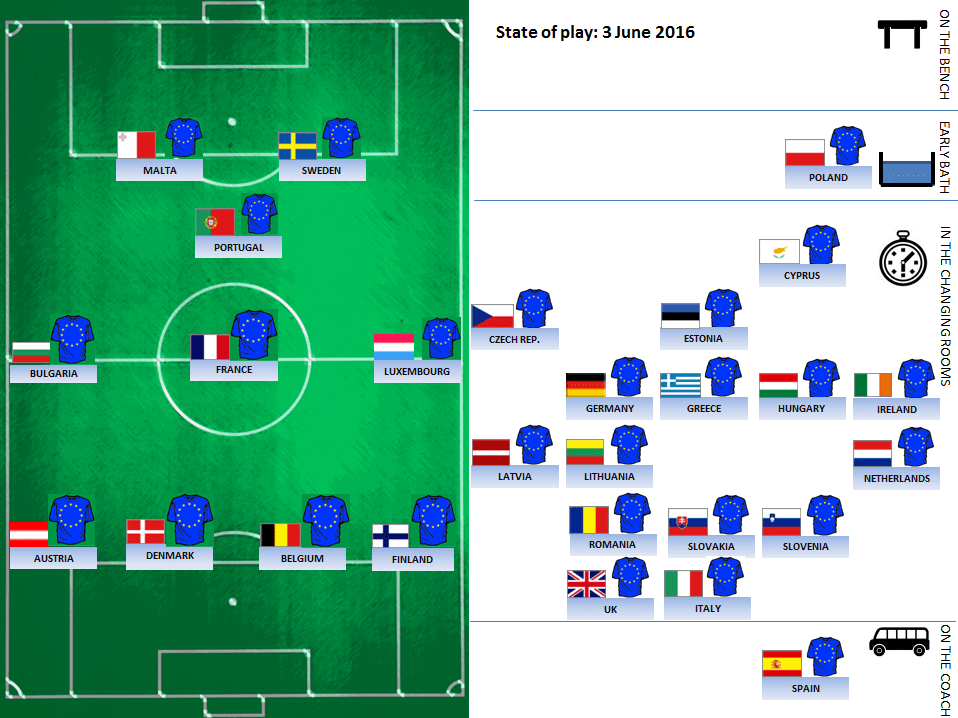
According to the website of the Council of the European Union, Bulgaria has now deposited its instrument of ratification (on 3 June 2016) to become the tenth country to complete its ratification formalities. Bulgaria joins Finland, Portugal, Luxembourg, Malta, Denmark, Belgium, Sweden, France and Austria as one of the ten countries who have completed their ratification processes.
The unitary patent system requires 13 countries to ratify including the UK, France and Germany meaning that just the UK, Germany and one other country are required to ratify to bring the unitary patent system into effect. The target date for the unitary patent system is currently May 2017.
(more…)
UPC developments: Wragge Lawrence Graham & Co’s Patents Seminar
 The always entertaining and informative Wragge Lawrence Graham & Co’s annual patents seminar was held last week and included a round-up of recent developments relating to the unitary patent and UPC. (more…)
Unitary Patent Package – The Ratification Game (Finland completes its ratification formalities)
 Update (19 January 2016)
According to the website of the Council of the European Union, Finland has now deposited its instrument of ratification (on 19 January 2016) to become the ninth country to complete its ratification formalities. Finland joins Portugal, Luxembourg, Malta, Denmark, Belgium, Sweden, France and Austria as one of the nine countries who have completed their ratification processes.
The unitary patent system of course requires 13 countries to ratify including the UK, France and Germany.

 IPcopy