
IPcopy writers
 ipcopy
 ipcopyamelia
 ipcopyaz
 ipcopyben
 ipcopydev
 ipcopyeleni
 ipcopyemily
 ipcopymanuela
 ipcopymark
 ipcopyrich
Keltie LLP

K2 IP Limited

New referral to EPO Enlarged Board of Appeal – follow up
 As noted in a recent post on IPcopy, the freedom for a patentee to amend claims during EPO opposition and opposition appeal proceedings is to be considered by the Enlarged Board of Appeal (EBA).
Since our earlier post we have heard mention of this referral from a member of the Technical Boards of Appeal at a seminar in London and have also had further comments from the Chairman of the case in question, including some suggestions as to when the referral will progress further. (more…)
UK Changes Divisional Deadline Rules [Updated]

Lord Younger signed the SI on 8 March
As mentioned on Monday by IPKat, the rules regarding time limits for filing divisional patent applications from UK applications are being changed.
Under the current system, if a notice of compliance under Section 18(4) Patents Act 1977 is received, the applicant would have two months within which to file any divisionals. The two month period is being maintain under the amended rule, however, there will be an additional requirement to meet. Namely, that the parent must not have received any objections in an examination report.
This means that if the parent was found to meet the requirements for grant after more than one examination, there would be no opportunity to file divisionals once the notice of compliance is received.
10 Points on the EPO Boards of Appeal
Today we have a guest post from Suleman Ali of Holly IP and K2 on the subject of the EPO Boards of Appeal. This post was originally posted on the Holly IP blog IP Trends and is reproduced with the permission of the author. There’s some interesting tidbits of information here from Appeal statistics to backlogs and from divergence between the Boards to the need to wear a tie! These points are gleaned from a talk by Alexander Clelland (ex-head of a Board of Appeal) given at the CIPA Life Sciences Conference on 14 November 2013.Representation at the UPC – feedback from Rules of Procedure Submissions
 A CIPA/IPO meeting back in January (covered in posts here and here) looked into the issue of representation in front of the Unified Patent Court (see Rule 286 of the Rules of Procedure) and in particular whether UK patent attorneys will automatically have that right, might be “grandfathered” in or might have to sit some sort of additional qualification.
Back in October last year IPcopy collated a few of the submissions sent in response to the public consultation on the Rules of Procedure of the Unified Patent Court and last week the 16th draft of the Rules of Procedure published accompanied by a handy “comprehensive digest” that explains some of the reasons behind the changes to the Rules. We thought we’d take a quick look at both the original submissions and the comprehensive digest to see whether any of the respondents touched on this issue as well.
Out of the 12 submissions we listed back in October, three addressed the issue of representation and the comments made by the Association of IP Professionals in Swedish Industry, Bristows LLP and the IP Federation (the IP Fed paper downloads as a PDF document) are noted below. There are also a fair number of comments in the digest document (though the three listed above do not appear to be there). (more…)
Speculation on the Unitary Patent Renewal Fees: Graphs, graphs, graphs and a prediction
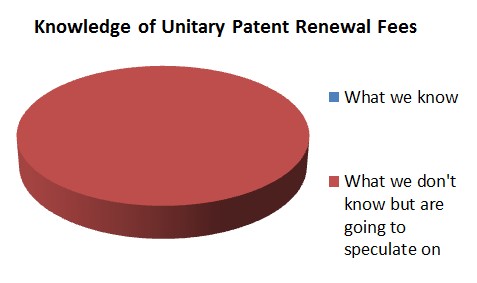 Cast your mind back to December 2012 when the Unitary Patent Regulation and Unified Patent Agreement were approved by the European Parliament, and you may recall a lot of press releases explaining what great value for money the unitary patent would be. In particular, we were told that the unitary patent would bring patent protection in Europe financially in line with patent protection in other countries, such as the US and China.
Back then, the fees relating to the unitary patent were completely unknown. Fifteen months later, we know little more than we did then: it seems likely that there will be no fee for validating a unitary patent, and rumours are that the opt-out fee will be in the region of €50 – €100, but we are still in the dark when it comes to the most important fees of all: the renewal fees of the unitary patent. The only titbit that has recently escaped the lips of anyone in the know came from the EPO president, who said cryptically in December 2013 that the renewal fees would be “higher than many would hope, but lower than some might fear”.
The level at which the renewal fees are set will be key in determining whether the unitary patent can deliver on its promise of value for money. The Select Committee responsible for setting the renewal fees must balance on the one hand the need to keep the unitary patent financially attractive to industry, and on the other hand the need for the unitary patent to be self-financing. The second part of this equation is difficult for us to assess from the outside. The first half, however, is susceptible to a bit of speculation.
So, in this post, which will feature a lot of graphs, we will be taking a look at how value-for-money (in terms of renewal fees) differs among countries within the EPC and how the EPC and Unitary Patent countries currently compare to the US and China, and we will consider what level the Unitary Patent fees might need to be if they are to match the value-for-money offered by Chinese and US patents. We’re even going to go so far as to put out a prediction. We fully expect to be proved completely wrong, but hope that throwing out some actual numbers might generate some interesting discussion from commentators…
European Patent Litigation Certificate (Draft Paper now online)
Last week IPcopy wrote about a draft paper from the legal working group of the preparatory committee that discusses the European Patent Litigation Certificate and the other “appropriate qualifications” that are mentioned under Article 48(2) of the Unified Patent Court Agreement and are required for EPAs to have rights of representation at the UPC.
At the time of writing last week’s article the draft paper was not online but this changed over the weekend when the Twitter user @EPpatent posted a link to a Google docs copy of the paper. The draft paper can be found in our article European Patent Litigation Certificate (& other appropriate qualifications) which has been updated.
While you are checking out the draft paper, take a look at some of the comments on the earlier post, especially the one from IP Frog!
Mark Richardson 10 March 2014
16th draft of Rules of Procedure of Unified Patent Court
The 16th draft of the Rules of Procedure of the Unified Patent Court has been published and can be found here (16th draft of Rules of Procedure). Helpfully the latest draft has been prepared as a marked-up document which means the amendments are easy to spot.
There’s a fair amount of red lined comments in this draft which IPcopy will take some time to digest. However, a few points of interest are noted below.
Nordic Baltic Regional Division Established & Brussels I Regulation Amendments
 A couple of unitary patent news updates courtesy of Nick Cunningham and Michael Carter at Wragge & Co. relating to the signing of the Nordic Baltic regional division of the Unified Patent Court and the approval of the amendments to the Brussels I regulation.
What became of the Trunki? Magmatic v PMS at appeal
 Back in September we reported on the result of the Magmatic v PMS case in which the Trunki faced off against the Kiddee Case at the High Court before the Hon. Mr Justice Arnold. At the High Court, PMS’s Kiddee case was found to infringe Magmatic’s Community Registered Design (CRD) for the Trunki.
However, PMS were given leave to appeal the case, and in January the case was heard in the Appeal Court before Lord Justice Moses, Lady Justice Black and Lord Justice Kitchin. The judgement has just been made available, and reveals that the Appeal Court reversed the High Court’s judgement, and ruled that the Kiddee case did not, in fact, create the same overall impression as Magmatic’s CRD, and so did not infringe. IPcopy takes you for another ride through the suitcase-animal fair…
European Patent Litigation Certificate (& other appropriate qualifications)
[Note: see also the post on 18 June 2014 relating to the public consultation for the EPLC proposals. Closing date is 25 July 2014. ipcopymark 18 June 2014]
Back in January this year CIPA and the IPO held a joint open meeting to discuss the issue of representation before the Unified Patent Court. This is a very important topic for patent attorneys and the CIPA/IPO meeting explored whether UK patent attorneys (who are EPAs) would have rights of representation at the UPC or whether additional qualifications would be necessary. IPcopy’s reports on this meeting are at the following links – Part I and Part II.
Last week an article went up on the Law Society Gazette asking “Who can act in European patents?” and reference was made in this article to a draft paper that has recently been produced by the legal working group of the preparatory committee. IPcopy had not seen this paper (or even heard of its existence) but the author of the Law Society article was kind enough to provide us with a copy. [Update: a copy of the draft paper has now appeared online and can be accessed here. 10/3/14]
In our view, if you are a European Patent Attorney, then this report does not make for happy reading. If the views expressed in the CIPA/IPO meeting are anything to go by then this seems especially the case if you are an EPA and UK patent attorney. IPcopy summarises the main points of the draft paper below. (more…)
Subscribe to RSS feed

 IPcopy