
IPcopy writers
 ipcopy
 ipcopyamelia
 ipcopyaz
 ipcopyben
 ipcopydev
 ipcopyeleni
 ipcopyemily
 ipcopymanuela
 ipcopymark
 ipcopyrich
Keltie LLP

K2 IP Limited

Bulgaria join Unified Patent Court Agreement Club
 As of 5 March 2013, Bulgaria is also a signatory to the unified patent court agreement. This brings the total number of countries who have signed the agreement to 25 (out of 27). Poland and Spain remain outside the club.
IPcopy’s Ratification Game post has been updated – see here.
The Press Release is here.
Mark Richardson 6 March 2013
Twitter’s patent agreement with inventors – a closer look

tweet tweet
The “smartphone wars” have been in the news for a while now and have spawned a host of comments about the use of patents and the amount of litigation in this arena. Amongst all this commentary you may have come across Twitter’s Innovator’s Patent Agreement (the IPA). Wired recently carried an article by Ben Lee who is the head of litigation and intellectual property at Twitter. The article can be seen here and the agreement itself is also available here.
Twitter suggest that they don’t want patents to impede innovation and the IPA is their answer. According to Twitter, the IPA essentially provides “a promise not to sue anyone unless for a defensive purpose”. We thought we’d take a closer look at the IPA and see whether it can deliver on its promise and what it means for Twitter.
UPC – The Ratification Game Update
 As noted in an earlier post the agreement on the unified patent court (UPC) was signed by 24 member states on 19 February 2013.
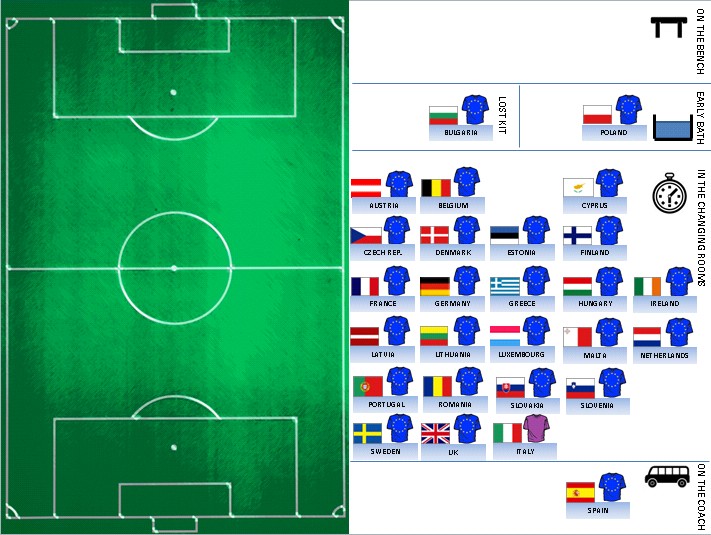
Spain, Poland and Bulgaria were the three member states who did not sign the UPC agreement. Spain are sitting out of the unitary patent package completely at present and so have not signed. Poland and Bulgaria are part of the enhanced cooperation club that the unitary regulations have been prepared under. Poland, however, has decided to take a wait-and-see approach and so did not sign the UPC agreement. Bulgaria intends to sign as soon as it has made appropriate preparations.
In light of the UPC signing ceremony the Ratification Game post has been updated along with the football info-graphic. The full post can be found here but in the meantime here’s the updated graphic.
We want to be guinea pigs too
 Following concerns that the strict patent infringement tests applied by the Courts in the UK are driving lucrative clinical trials overseas, the UK government has now concluded a review of the statute that would allow for a broader ‘Bolar’ exemption to enter UK law.
Power in Numbers – Trade Mark Squatters in China
 Trade Mark squatting is big business in China and is becoming more and more common. The new target appears to be up and coming European brands. It would appear that as soon as a mark becomes the slightest bit known in the UK, throughout Europe or the US, the marks are being filed as trade mark applications in China by opportunistic third parties known as trade mark squatters.
It would also seem that these third parties are not just trying to reap the rewards of just one trade mark either. It is becoming more common for trade mark squatters (which are now large ‘squatting’ companies) to file hundreds of well-known or well-publicised up and coming brands belonging to foreign owners.
Are the days of a section 11(1) TMA defence numbered? (TMA – Trade Marks Act 1994)
 “A registered trade mark is not infringed by use of another registered trade mark for goods or services for which the latter is registered (…)”(s.11(1)). This section of the UK Trade Marks Act 1994 (also referred to as “registered mark defence”) has generally been the basis for advising clients to obtain a UK trade mark registration in addition to a Community Trade Mark (‘CTM’) registration.
UK trade mark proprietors have been able to rely on the registered mark defence mentioned above as a prima facie defence to trade mark infringement proceedings. Prior to the EU decision below, the validity of a UK registered mark would have to be challenged first before infringement proceedings commenced. It would appear from the EUCJ ruling below that there may be a movement away from this defence.
Transitional provisions and the competence of the UPC: A response to Amerikat
Over at IPKat, Amerikat has been looking at the transitional provisions of the Unified Patent Court (UPC) Agreement and considering an interesting question. In this post, Amerikat has been considering Article 83, which gives a patentee the possibility to opt out of the ‘exclusive competence’ of the UPC if the patent was filed before the end of the transitional period, and to opt back in again at any time.
In brief, her question is this: does opting out of the ‘exclusive competence’ of the UPC still leave the UPC with non-exclusive competence, or does it leave the UPC with no competence at all (pun entirely unintentional)?
At IPCopy, we threw around some thoughts on this when we first noted quite how long the UK courts could still have competence as a result of Article 83 (Draft Article 58 back when we posted this), and we thought this was an opportunity to share them with you, and Amerikat! (more…)
Unitary Patent Package – UPC Agreement – 24 signatures received
After a reasonable delay the signing ceremony for the agreement on the unified patent court took place today (19 February 2013).
As alluded to in the press release a total of 24 member states signed the agreement, including Italy.
19th February 2013 is UPC signing day!
As announced here the signing ceremony for the agreement on the unified patent court will take place on 19 February 2013 (on or around 2.15 Central European time).
Control your excitement readers!
The press release for the signing ceremony also suggests that we will be able to live stream the entire event (at this location).
The IP Federation, the Minister and the European Scrutiny Committee
The IP Federation represents the views of UK Industry and, as can be seen from the front page of their website, has a pretty impressive list of members. As announced here the IP Federation has written to the UK Minister for IP (Viscount Younger of Leckie, Parliamentary Under-Secretary of State for Intellectual Property in the Department for Business, Innovation and Skills) with a request for an economic analysis to be performed on the effect on the UK economy of the unitary patent system before ratification of the unified patent court agreement takes place.
It will be interesting to see what, if any, response the IP Federation get from Lord Younger. On a related subject we note that the European scrutiny committee has recently cleared the Draft Agreement on a Unified Patent Court and draft Statute (see here for details).
Subscribe to RSS feed

 IPcopy